Investor Financing made Simple.
DSCR loans qualify on what your Florida rental earns — not your tax returns. Purchase, refinance, short-term rental, and the condo projects conventional lenders won't touch.
Qualify on the rent, not your returns.
A DSCR loan is a mortgage for investment property that qualifies on the property's income instead of your personal income. We compare monthly rent to the monthly payment — principal, interest, taxes, insurance and HOA — to get a debt-service-coverage ratio.
No W-2s. No tax returns. No debt-to-income calculation on you. Title in an LLC is commonly permitted, and the financed-property limits that cap conventional investors generally don't apply.
We're headquartered in Lake Mary and licensed across Florida. Insurance costs, flood zones and county tax swings are the three things that break out-of-state pro formas, and we deal with them every week.
Explore OptionsMike Dunlap
Senior Mortgage Loan Originator
 U.S. Marine Corps Veteran — Semper Fidelis
Popular Investor Options.
Four ways Florida investors use these programs. Guidelines vary by lender and by property — we'll tell you which one fits your deal.
DSCR Purchase
Buy non-owner-occupied single family, condo, townhome or small multifamily using the property's rent to qualify.
Cash-Out Refinance
Pull equity out of a stabilized rental to fund the next acquisition. Seasoning rules decide the timing — ask early.
Non-Warrantable Condo
Units in Florida condo projects flagged ineligible for conventional financing over insurance, reserves or repairs.
Short-Term Rental
Orlando, Kissimmee and Tampa. Some programs use documented STR income, others underwrite to long-term rent.
Program parameters vary by lender and by property. Criteria shown are typical of investor programs generally and are not an offer of terms. All loans subject to underwriting approval; not all applicants or properties will qualify.
Check your deal with our easy-to-use DSCR Calculator.
Rent divided by payment gives you the ratio. At 1.00 the property covers itself. At 1.25 most investor programs treat it as strong. Below 1.00 there are still options, but the structure changes.
No credit pull, no signup. Run the numbers, then send us the scenario and we'll tell you straight whether it works.
At 1.25 and above, the property covers its own debt service with room left over — the range most investor programs treat as strong.
Send This Scenario OverIllustration only. Not a quote, an offer, or a commitment to lend. Actual qualification depends on the property, the program, and full underwriting review.
The condos conventional won't touch.
Some Florida condo projects get flagged ineligible for conventional financing — insurance shortfalls, reserve gaps, open structural repairs. The industry calls these non-warrantable, and most buyers can't get a loan on them.
Which is exactly why units in those buildings trade below the rest of the market. If you can finance where conventional can't, that discount is the deal.
Send us the building and the numbers. We'll tell you straight whether it works.
Send Us The Building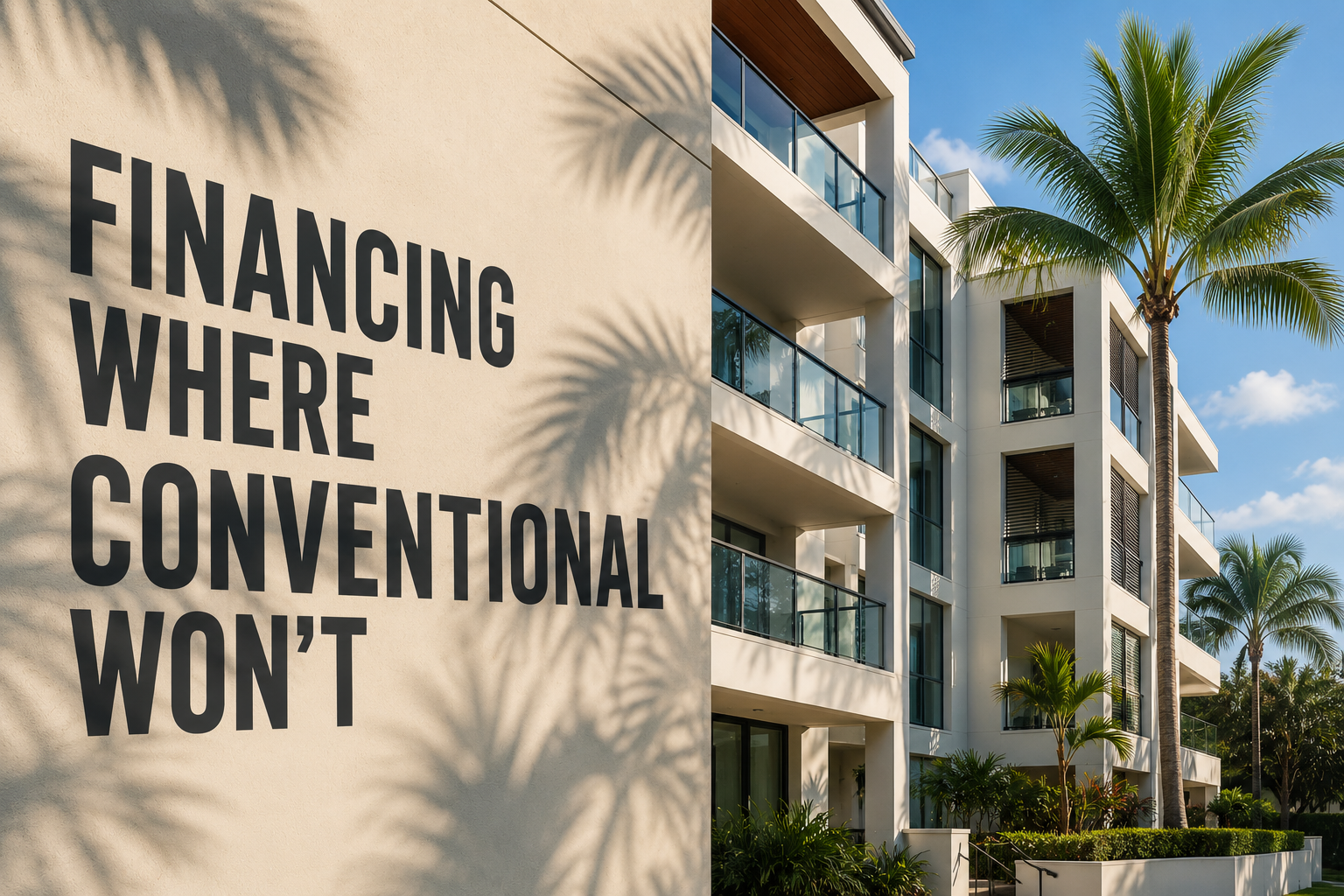
DSCR vs. a conventional investor loan.
Both finance rental property. They ask completely different questions to get there.
| Underwriting Factor | DSCR Loan | Conventional Investor Loan |
|---|---|---|
| Primary test | Property's rent vs. its payment | Borrower's debt-to-income ratio |
| Income documents | Generally none from the borrower | Tax returns, W-2s, pay stubs |
| Self-employed borrowers | Write-offs don't work against you | Write-offs reduce qualifying income |
| Title in an LLC | Commonly permitted | Generally not permitted |
| Financed properties | Generally not capped | Agency limits apply |
| Short-term rental income | Often usable, program depending | Difficult to use |
| Reserves | Typically required | Typically required |
General comparison for orientation only. Guidelines differ by lender, program, and property, and change over time.
Send the scenario. Get a real answer.
No credit pull to get a read. Tell us about the property and we'll tell you where it stands — usually the same day.
- 01Same-Day Response
Send it during business hours and you'll hear back the same day. - 02A Licensed Originator, Not A Call Center
Mike Dunlap, NMLS #1305423. - 03Straight Answers
If the deal doesn't work, we say so and tell you why.
Questions investors actually ask.
What DSCR do I need?
Most programs want the property to at least cover its payment — a ratio of 1.00 or better. Ratios of 1.25 and above are generally treated as strong. Some programs will look at properties below 1.00 with adjustments to the structure. The ratio isn't the only test; credit, reserves and the property itself all factor in.
Do you check my income at all?
Not the way a conventional loan does. DSCR programs generally don't calculate debt-to-income or ask for tax returns and W-2s. Credit is still reviewed, assets and reserves are still verified, and the loan is still fully underwritten. Anyone telling you underwriting is skipped is telling you something that isn't true.
Can I close in the name of my LLC?
Usually yes. Holding title in an entity is one of the main reasons investors choose DSCR over conventional financing. You'll provide the operating agreement, articles and EIN, and personal guarantees are typical.
What makes a condo non-warrantable?
Common triggers include insurance coverage below agency requirements, inadequate reserves, deferred maintenance or open structural repairs, high investor concentration, or too much commercial space. Fannie Mae maintains a list of projects it treats as ineligible, and it isn't public — owners usually find out when a contract collapses.
Does short-term rental income count?
Program depending. Some lenders will use documented short-term rental history or a market rent analysis for the STR use; others underwrite to long-term market rent regardless of how you plan to operate. In the Orlando and Kissimmee corridor this is the single most important question to settle before you go under contract.
How many properties can I finance?
DSCR programs generally aren't subject to the financed-property limits that apply to conventional agency loans, which is why investors with larger portfolios move to them. Individual lenders may still set their own exposure limits.
Is a DSCR loan a business-purpose loan?
These loans are made for business purposes — acquiring or refinancing income-producing property — and are not intended for personal, family or household use. The property must be non-owner-occupied. That distinction matters, and we'll walk through it with you.